BLOGGER TEMPLATES AND TWITTER BACKGROUNDS

Group 2 'Mute' Finished Opening Sequence

Finished Preliminary task - 'The Transaction'

Showing posts with label evaluation. Show all posts

Tuesday, 5 April 2011

Evaluation Question 7


7) Looking back at your preliminary task, what do you feel you have learnt in the progression from it to the full product?


Preliminary Task Brief


Produce a continuity task involving filming and editing a character opening a door, crossing a room and sitting down in a chair opposite another character, with whom he/she then exchanges a couple of lines of dialogue. The taskshould demonstrate match on action, shot / reverse shot and the 180-degree-rule.

Main Task Brief

The titles and opening of a new fiction film, to last a maximum  two minutes. All video and audio material must be original, produced by the candiadate(s), with the exception of music or audio effects from a copyright-free source.

 
Pre-production stage

We learnt from the preliminary the utmost importance of full scripting and storyboarding, doing location scouting and securing the locations and actors well in advance of our shoots. Problems such as leaking sound from other rooms during the prelim task made us realise that you really cannot just film whenever and wherever you want; it requires permission and much planning.
After the prelim task raised several issues in regards to getting the shots we needed, we decided for our real project that we would do some test shoots for certain sequences in our film. This helped us iron out and work around impracticalities or difficulties which would arise during the real shoot, saving us time and effort.
Here is a video of a test shoot we made, to help us fully visualize and plan our second shoot for 'Mute':


Production stage


The preliminary task focused on continuity, and it made us realise just how much attention needs to be paid to continuity throughout the entire process of constructing our sequence. It is very difficult to create a continuity perfect sequence, as we discovered with the prelim, but giving us some practise at it really helped our final sequences seem as slick and professional as possible. However, we still encoutered some continuity issues with our sequence:
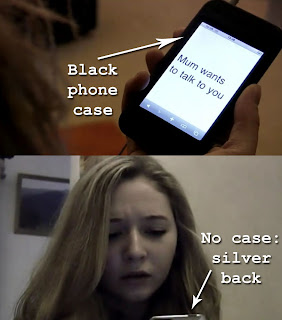


A continuity error in our sequence

The prelim task also showed us how long it really can take to fully complete a shoot. It takes a huge amount of time and cooperation between you and your team, and you need to find an equilibrium between all your creative inputs and your practicalities.
We also learnt from the prelim task that it is necessary to alternate between the various production roles. This allows you to develop experience in directing, producing, acting, lighting, using the camera etc. Because of this, as a group we worked together to ensure everyone was allowed to explore the different fields of production as much as possible; while still creating a polished and successful sequence.


Post Production

From the prelim task, we were extremely limited in our amount of editing time; we only had about an hour to edit it together. However, it was much more basic- the soundtrack and dialogue were very simple, it was only a minute long, and contains no fast paced action. Also, it was all shot within one room, meaning good continuity was easy to maintain as we kept the room exactly the same throughout the shoot.

It showed me just how long the editing process can take, and that you always need to allow much more time that you think is necessary. It also helped us understand how hard it is to create a seamless flowing narrative with limited editing time. Because of this we gave ourselves as much time as we could to edit our sequence together- more time means a higher quality product.

Here is a shot of our group working across the different stages of production:

Evaluation Question 6

6) What have you learnt about technologies from the process of constructing this product?

While already experienced in several areas of film production, i furthered and developed many skills while constructing our sequence, across all the hardware and software which we used.

Hardware

I knew how to handle a camera on a fairly basic level before this project, but now my competence with it has increased as we learnt new techniques to help make our project a success.

For the first time, we decided to change the manual settings of our camera instead of just leaving it on the 'auto' setting as we shot. We tried several techniques with the manual settings, changing the lighting, contrast and fps of our footage from the camera itself.

We learnt how to focus pull, and we thought it would look very professional to include a couple of focus pulls in our final sequence (which we did), and here is a short video of us practising different focus pulls:


Using a tripod and other camera attachments were fairly straightforward in this project; as much of our sequence was filmed handheld without a tripod. However, this did make some of our shots shakier than expected, something we did not intend.

While i did learn a lot about the hardware we were using, there were no huge leaps from using a camera and equipment before; so we did not find ourselves too challenged. However, we did really explore the creative possibilities that the new and exciting software could provide for our sequence.

Software

Adobe Premier Pro

The main editing software we used in our project. We had worked with Premier Pro before on our GCSE project, so i already had some experience, but i feel much more confident after spending several more weeks editing our sequence.

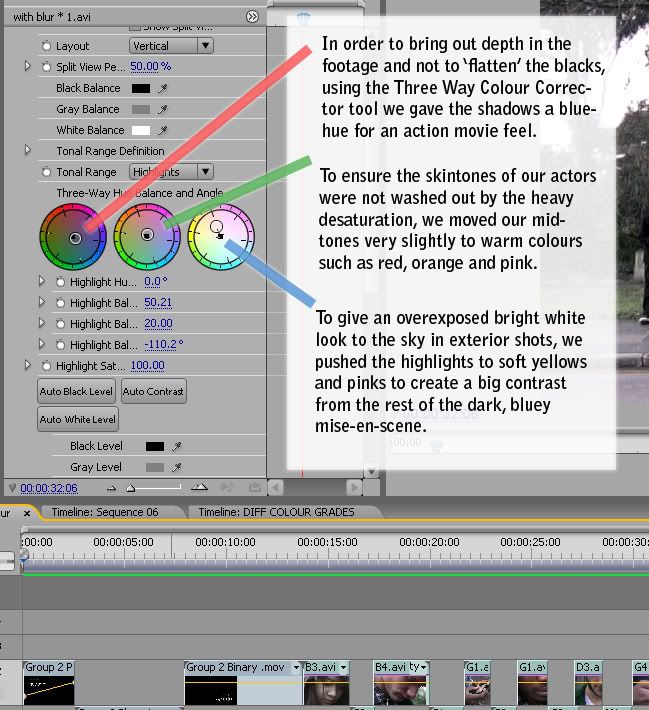
We also explored many techniques of editing and grading our footage, using two tools i had not used before: ProCamp and Three-Way Colour Corrector to help color grade our sequence, achieving the washed out colour palette often seen in action movies. We began with absolutely no experience of using these tools, effectively employing trial and error while working, but after weeks of work i would feel confident to work with them again.

This picture demonstrates the use of the Three-Way Colour Corrector tool we used.

Here is a video we produced of our sequence, with different colour grading effects applied:


We also improved our ability to equalize sound between shots, and to use the high-pass effect when Ava removes her headphones; making the transition between music and eerie silence as convincing and professional as possible.

Adobe After Effects

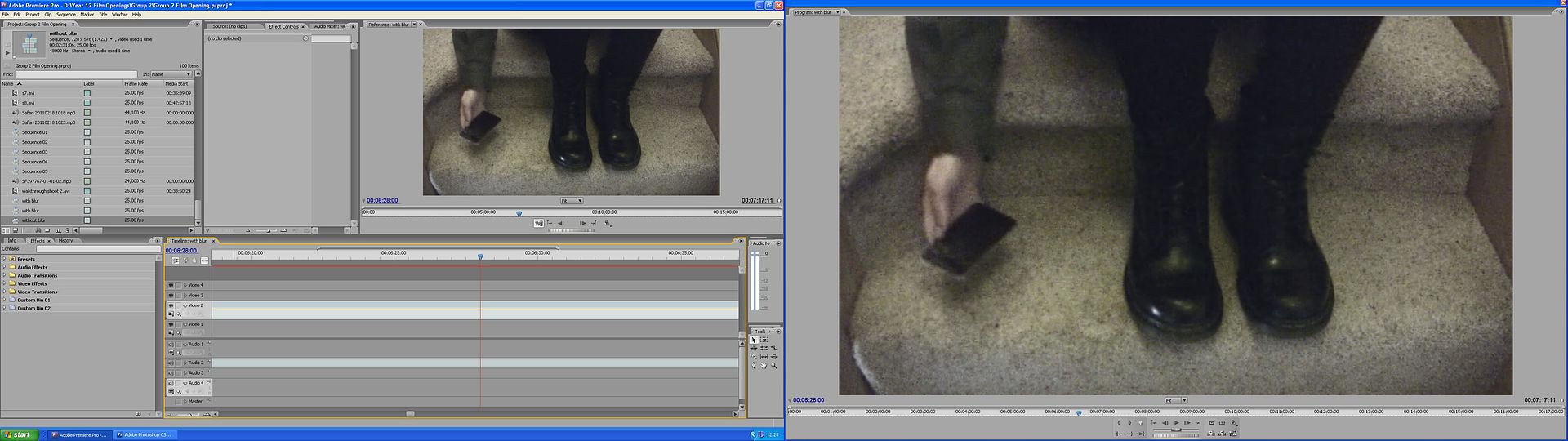
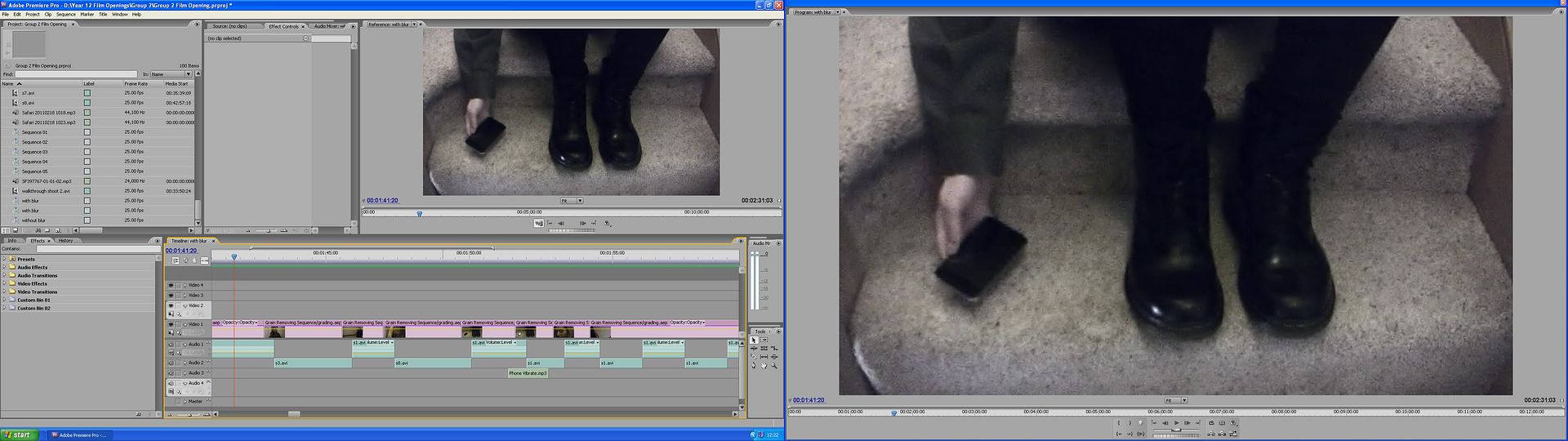
I had never used After Effects before, but we used to to apply the Degrainer effect to some of our footage, after we found it to be much grainier than we expected. This was probably because we filmed in a low light section of my house, and did not fully utilize the pag-light while filming.


The top shot shows our footage before the Degrainer was applied, the bottom shot after it had been applied.

We also used the software LiveType to help make our titles exactly how we wanted them; and to make them look as professional as possible.

If i was doing this project again, i would have fully utilized all the technology at my disposal, much like we did in this project. I would have tried to do a video storyboard and test shoot, which would have helped make the production process run as smoothly as possible.

Evaluation Question 5

5) How did you attract / address your audience?

We attracted our target audience of young people by using a young cast, with the three leads being teenagers. Teenagers can relate to our rebellious lead character, attempting to overthrow the oppressive government authority.

Our film has an edgy and contemporary style which would also hold strong appeal for a younger audience, the pacey editing and thrilling plotline is a good hook for a younger audience looking for thrills in a film. The heavy influence of technology in our film is also appealing for younger audiences, as they can relate to always being on their phones, and 'Mute' provides an insightful social commentary about this dystopian world where technology has taken over. Our storyline contains many conventions of an action film which would attract fans of the genre, such as chase scenes, a 'saving the world' scenario, and a lead hero to propel the narrative, but we think that teenagers want to see something fresh and exciting on their screens as well as the standard conventions of an action / drama film. To do this, we have an intelligent plot full of twists and turns, deaths of main characters, a partially unresolved ending and moments of shocking drama.


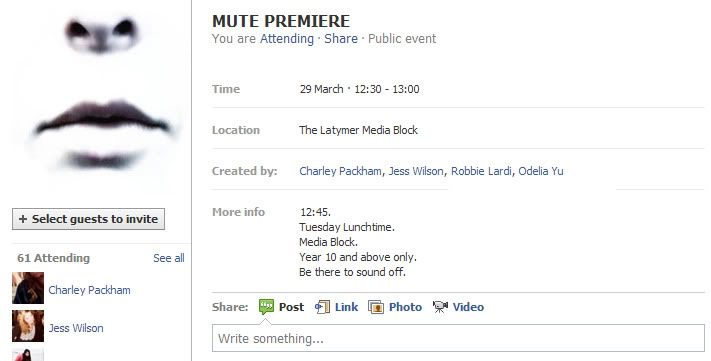
Here is the Facebook event we created to attract our audience to our screening. Facebook is a commonly used platform by our target audience of 15-25 year olds, and so we thought this would be the best way to promote our screening. The poster and information mimics the style of the film; it is edgy and minimalistic, creating enigma for the audience and enticing them to come to our screening. 


Being a British film, our primary national audience is Britain. We reflected this in 'Mute', most obviously by setting the film in London and having a predominantly British cast. This is furthered through our choice of music. Not only is drum and bass music such as ours mostly listened to by young people, it also holds strong British roots; you wouldn't find that music being produced in many other countries at all. It helps stick to our British brand identity, and will help attract a young British audience. The gritty style of 'Mute' is also something which our audience would relate to other popular independant British flicks or TV shows, such as Kidulthood (Huda, 2006) or Misfits (British TV Drama, 2009 - present).

We attempted to address the multi cultural aspect of modern day London by including actors of different races; caucasian British, Asian and African-American actors are all present in our sequence, which helps provide an accurate portrayal of London, and will help attract a racially diverse audience.

Racial Diversity in 'Mute'


Monday, 4 April 2011

Evaluation Question 4

4) Who would be the audience for your media product?

Our film is rated 15, and the primary target audience is both genders aged between 15 and 25. It would primarily appeal to fans of the action / drama genre, but as our film has a love story and elements of Sci-fi as well, we think we will attract fans of other genre's too. 

However, the fans of the typical Hollywood action blockbuster may find this film too dark or alternative for their tastes. The 15 rating allows us to include more graphic violence and swearing in 'Mute', as well as an incredibly dark tone throughout the film and several hard-hitting moments of drama, such as deaths of main characters, something not often seen in large scale blockbuster movies. We are aiming for an audience which is looking for something deeper and more intriguing than your run-of-the-mill generic action movie; 'Mute' is smarter and challenges many conventions of the modern action genre.

The film is primarily aimed at a British audience, as it is a British production and has a British cast, but has global appeal as well, allowing for a broader audience than simply Brits. 

We feel the heavy focus on technology in the film will have a large impact on our audience. We believe it will attract a young, tech-savvy audience, of both genders. This also opens up many possibilities in terms of marketing our movie. 

We showed our sequence to over a group of over fifty 15-17 year olds, and asked them to fill out a feedback questionnaire on what they saw. Here is a sample of some of the questionnaires we recieved:

Mute - Filled In Questionnaires

Every rating we recieved ranged between 6 and 10 out of 10, and the majority said they would watch the movie in cinemas, which shows that we successfully appealed to our target audience. 

Evaluation Question 3

3) What kind of media institution might distribute your media product and why?


Our production company is called Binary Studios, and we specialise in gritty British drama's, often with elements of science fiction- such as the dystopian world of 'Mute'. Our films could be likened to other independant British productions such as This is England (Meadows, 2006) or Hot Fuzz (Wright, 2007).


British companies are not particularly famous for their action films, and 'Mute' attempts to challenge this convention by providing a large scale, action filled plot, but combined with the strong script, characters and distinctive style which has made British cinema so recognisable and successful in recent years.


Phoenix International are distributing 'Mute'. They are an international company as while 'Mute' remains firmly a British production, we believe it has global appeal due to it's interesting characters and accessible storyline; so is intended to be exhibited nationally to begin with, and then furthered with a limited global release.


An example of a real distributor who might distribute our film is Fox Searchlight Pictures, who do not distribute massive, epic movies such as Avatar (Cameron, 2009), but instead lean towards more independant and British productions such as Slumdog Millionaire (Boyle, 2008) and Sunshine (Boyle, 2007). The two films mentioned are also good examples of British made films which maintain global appeal.


Fox Searchlight pictures, being a division of the much larger conglomerate 20th Century Fox, would also be able to fund any future sequels or franchises if the film was a commercial success.

Evaluation Question 2

2) How does your media product represent particular social groups?

Females

We decided to represent women in a different way than would normally be seen in an action movie. Here is the protagonist of our film, Ava:


We thought that the roles of women in action movies were often highly stereotypical, with women portraying 'the damsel in distress' role and often simply being a love interest for the main lead, male role. 

This is how a female character would traditionally be represented in an action film:


This is Megan Fox in Transformers 2: Revenge of the Fallen (Bay, 2010), and she is an example of a stereotypical woman character in an action movie. She is highly sexualised, wearing skimpy clothing and lots of make-up, and plays the love interest of the male lead in the film. We thought it would be much more interesting to challenge these conventions of women in action films, by having a female lead who does not conform to the typical stereotypes. 

We dressed her in more neutral clothing, as opposed to girly clothes, including black boots, black jeans and a green combat jacket. We thought this helped deter the common sexualised portrayal of women, that Ava is a smart and tough girl, who is much more than simply a damsel in distress or love interest. However, she is still a beautiful girl with curly blond hair; making her relatable also to the more girly girls who would watch 'Mute'. 

Teenagers

We turned the traditional representation of teenagers being obsessed with technology on it's head; shaping a world where everyone, young and old, is completely engrossed in their phones all the time. 

While it may seem like a typical portrayal of teenagers at first, with them all on their phones at the bus stop, we also see a younger boy and middle aged woman using technology as well, and it soon becomes apparent that everyone in the world is hooked on their mobile phones, not just teenagers. 

Also, the main three teenage characters completely challenge this stereotype, as they spend the duration of the film trying to stop this dependancy on technology, while the adult characters in the film are the ones trying so desperately to keep everybody on their mobiles.

Here we see everyone except Ava engrossed in their mobile phones:


Evaluation Question 1

'Mute' - The new action / drama film from Binary Studios'


1) In what ways does your media product use, develop or challenge forms and conventions of real media products?


a. Genre

The Genre of our film is action / drama, while our film does follow many conventions of other action / drama movies, it maintains our own brand image and has many characteristics of an independent film. 

We attempted to make our film look like other action movies by adding a colour grade effect over our sequence, and using moody lighting to help set the mood of this dystopian society dominated by technology. We took inspiration from other action movies which frequently adopt the same bluey grey colour palette, such as The Bourne Supremacy (Greengrass, 2004).

In this clip from the second Bourne movie, we can see the washed out color palette and grey lighting which is common in lots of action movies; a convention we wanted to follow with our sequence.


Here we see some stills from various action / drama films which all use the washed out colour palette


Action films often open with an exciting chase or fight, often to help frame the rest of the movie. In this way, our sequence challenges the convention, as there is no action in our two minutes. There are no guns or chasing, we simply begin to get a feel of this strange world in which our film is set. 

Take for example, this clip from The Dark Knight (Nolan, 2008), as an example of a common action movie opening.


However, our opening does begin quickly, with loud and frantic music - common in action movies so as to grip the audience immediately.


The dreary urban location we use in our sequence is also common in action movies, such as I Am Legend (Lawrence, 2007). The heavy influence of technology in the world of 'Mute' is also becoming a common theme in modern day action movies. Films like Eagle Eye (Caruso, 2008) or I, Robot (Proyas, 2004) are quite similar to ours; set in a dystopian world where technology has become something more sinister, using many mobile phones and computer screens throughout the film.


b. Narrative Structure


Our film fits nicely into Todorov's Theory of Equilibrium. The theory suggests films begin with a state of balance, or equilibrium, followed by the disruption, and ending with the resolution of the disruption.


- Equilibrium -


Our protagonist, Ava, is living in her speechless world. She is contented, if not overjoyed, and things are very normal to begin with.


- Disruption -


Ava gets caught up in a large government conspiracy when she finds two boys who can still speak; attempting to reach a group of rebel scientists trying to develop voice boxes and overthrow the oppressive authority. The government, who enjoy the capacity to manipulate a silent country, attempt to hunt down Ava and the boys before they can reach the scientists.


- Resolution -


Ava and Ben (the other boy dies in the chase) reach the scientists before the government can stop them, and the government coverup is exposed to the world; the new voice boxes meaning everyone can speak again. Ava and Ben fall in love, and she goes back to her life, happy.


However, we decided to end the movie with a disruption, to set up for possible sequels. After  everyone has their voices back, we see a shady government group discussing their plans to kill Ava and Ben, covered up with claims that the voice boxes are infected; thus silencing the world once again. This adds enigma and suspense to the end of the film, and would attract audiences to potential sequels.


Characters


Our film follows many character conventions of action films, while breaking some as well. We have 'the unlikely hero' scenario present in many action films, wherein a seemingly normal citizen is plunged into chaos and a large scale event, often saving the world in the process. Ava is our 'unlikely hero', but is a girl, which is less common in large action movies. She is also much younger than a normal movie protagonist. 
We have a love interest for Ava, but this is a man as opposed to the usual woman love interest. The victim of the film is the second boy after Ben, breaking the convention as he is an attractive young man and a lead character in the film who drives the plot; not the most common character to kill in an action film. 


Our villain is not an obvious antagonist, but is the faceless government organizations which attempt to track down and kill Ava and the boys throughout the film. They are represented through disembodied voices which communicate through text, and a large number of guards and soldiers which chase our hero's. This breaks the convention of an obvious villain which is seen in many action movies.


Techniques


The opening of our sequence is not edited together in real time, but is a montage sequence.


We did this to help establish the dystopian world in which 'Mute' is set, attempting to create pace and suspense, and to build enigma; as the audience would be immediately intrigued as to why all these people in this world seem to be so engrossed in their phones. Many films open with a montage sequence, ours being quite similar to Phone Booth (Schumacher, 2002) which both set up technology as a theme with a heavy impact on the plot of the movie.

The establishing shot of our sequence creates a clear binary opposite between Ava and the other characters at the bus stop with her, as she is the only one not texting on her phone. This helps establish her character as well, that she is a rebel and does not conform to her society of endless technology.

The rest of our sequence is edited in a more traditional method, in real time. It slows down the pace and helps fully establish the world Ava lives in, introducing us to her family and (with the news article at the end), setting up the main plot of the film. We learnt about continuity theory from producing our preliminary sequence, and it taught us that continuity is important to help the audience suspend their disbelief and produce a seamless, flowing narrative. We utilized techniques such as eyeline matching between characters, the 180 degree rule and match on action to help make our video as professional and seamless as possible. Continuity is extremely important, and must be considered throughout all stages of production and planning. We also needed to consider continuity in regards to sets, lighting changes and costumes.


c. Form

Opening sequences of movies, while they differ wildly, can take two approaches with regard to setting up the rest of the film. They can either begin in the chronological order, starting at the beginning of the story, or they can begin at a point which occurs later in the overall narrative, and jump back to the beginning to show how events progressed to that point.

It is much more conventional for films to simply run in chronological order, starting at the beginning, which is what we chose to do for 'Mute', as we decided trying to incorporate flashbacks and a jumpy narrative would be confusing and difficult to convey in our already complex film.

Either way, the most common feature of an opening sequence is to establish the protagonist and the setting of the film.  See this convention in this opening sequence from Face/Off (Woo, 1997). It establishes John Travolta's character as the main protagonist of the film.


Our opening sequence begins at the start of Ava's story, and follows the convention in that it introduces her (our protagonist) and the speechless world in which she lives. It also begins to set up her character and relationships, showing her rebellious nature as she is the only person not on her phone at the bus stop, and we see her not-so-perfect relationships with her mum and brother.

Just as opening sequences often provide some enigma and clues as to which direction the plot will take, we included this in 'Mute' with the final shot of our sequence, the zoom in on our news article. This article is the first taster of the key themes and plot of the film, and is intended to entice the audience.

See here the enigmatic zoom we used as our final shot:
Our sequence opens conventionally with the names of our distributor, Phoenix International, and our production company, Binary Studios, before the delayed reveal of the title of our film, 'Mute'.

d. Style

While conforming to many conventions of large scale action / drama films, we wanted to maintain a certain British and 'gritty' feel to our film, as we are an independant British company, not a large Hollywood studio. We wanted to make it look slightly different; the palette of colours we use has much less blue than usual, and is shot and edited in a more 'edgy' kind of style. 

The framing of our shots is much tighter than a normal action / drama movie; we use many CU's in our film, with cuts between multiple close up's of the characters edited to be purposefully choppy. This keeps in with our brand image and feel of that gritty Britishness which is not present in many blockbuster and large-scale action movies. Here are some examples of CU's we used in our film.


The CU's also help the audience engage in the world on a personal level, and help engross them in the action. We see many blank, expressionless faces, frantically tapping away at their mobile phones, and this helps set the tone of the dystopian world in which 'Mute' is set.

The editing of our sequence is pacey, with the montage sequence filling the first half, and a quick moving introduction of Ava's home life, before the set up of enigma as the final shot of the sequence. Things move quickly, and we showed this also through our choice of music - a fast and upbeat drum and bass track. The electronic nature of the music ties in nicely with the recurring theme of technology in 'Mute', and the fact it is drum and bass helps firmly establish the British roots of the film and our identity as a British production company.

We incorporated another example of a binary opposite in our sequence when Ava removes her headphones as she enters the house. The scene goes from being very loud and energetic, to an eerie silence; we included no ambient noise at all at this point to help increase the impact of this moment- it is the first time the audience is introduced to this speechless world. 


This is our title card, we chose the font and style specifically to reflect the themes and tone of our theme. It is simplistic, black and white, and heavily technology influenced.


Our credits themselves roll over the footage, as we didn't want to waste valuable screen time with just a black background. Considering most of the credits roll over the montage sequence, we found they were not too intrusive to the narrative of the sequence at all. This is common in action films; the credits are small and relatively discreet in the bottom corners of the screen, so as not too distracting.